

Why a simple habit like walking might do more for your focus, memory, and mental fog than you think backed by real research.
By Aditya Dev Ranjan
The Study That Changed How Scientists Think About Exercise and Memory
- Aerobic exercise increases the size of the hippocampus, the brain region responsible for verbal memory and learning.
- Resistance training, balance exercises, and muscle toning did not produce the same effect.
- The benefit appears to be specific to aerobic activity.
- A new case of dementia is identified roughly every four seconds worldwide.
- More than 115 million people could be living with dementia globally by 2050.
- Regular activities like brisk walking can lead to measurable changes in the brain.
- Six months to one year of regular, moderate-intensity exercise is linked to increased volume in specific brain regions.
- These changes are physical and measurable, not just improvements in mood or energy.

What’s Actually Happening Inside Your Brain
This isn’t just correlation — there’s a documented biological mechanism behind it. A neuroscience review on
exercise and brain function outlines several pathways through which physical activity directly changes brain
chemistry and structure:
● Brain-derived neurotrophic factor (BDNF) rises with exercise, which supports the growth and survival
of neurons.
● Vascular endothelial growth factor (VEGF) drives the growth of new blood vessels in the brain,
improving blood supply.
● Insulin-like growth factor (IGF-1) plays a role in exercise-driven blood vessel growth in brain tissue as
well.
● Because the brain runs on oxygen and glucose, better blood flow through increased capillary density
directly supports neuroplasticity — the brain’s ability to form and reorganize connections.
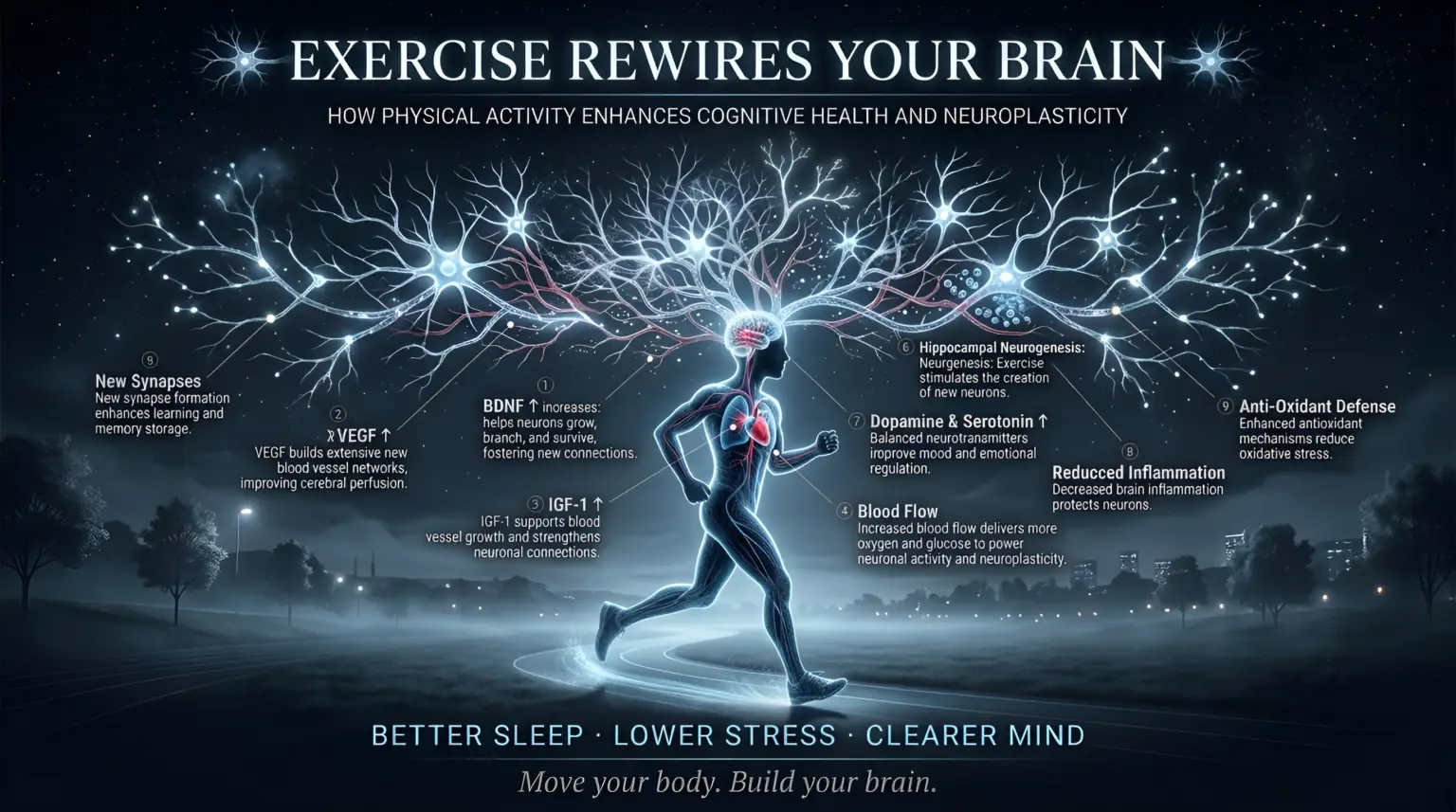
Put simply: exercise doesn’t just distract you from stress or tire you out enough to sleep better (though it does both of those too). It appears to trigger a cascade of biochemical changes that build a brain with more capacity to learn, adapt, and retain information.
There’s also an indirect route. Exercise reliably improves mood, sleep quality, and stress and anxiety levels —and all three of those are common, well-established contributors to brain fog and impaired thinking when they’re
out of balance.
So even setting the direct neurological mechanisms aside, fixing sleep and stress through
movement alone tends to sharpen mental clarity.
Why This Matters Beyond “Brain Health”
If you’ve ever dealt with mental fog — that feeling of moving through your day half-present, unable to focus, forgetting things you’d normally remember easily — this research offers a genuinely useful, non-pharmaceutical starting point.

How Much and Which Exercise Is Actually Required?
This is the part people usually expect to be complicated, and it isn’t. In the UBC research, participants walked briskly for one hour, twice a week — about 120 minutes of moderate-intensity activity weekly.
That’s close to the standard public health recommendation of roughly 150 minutes of moderate activity a week, or about half an hour most days.

Leave a Reply