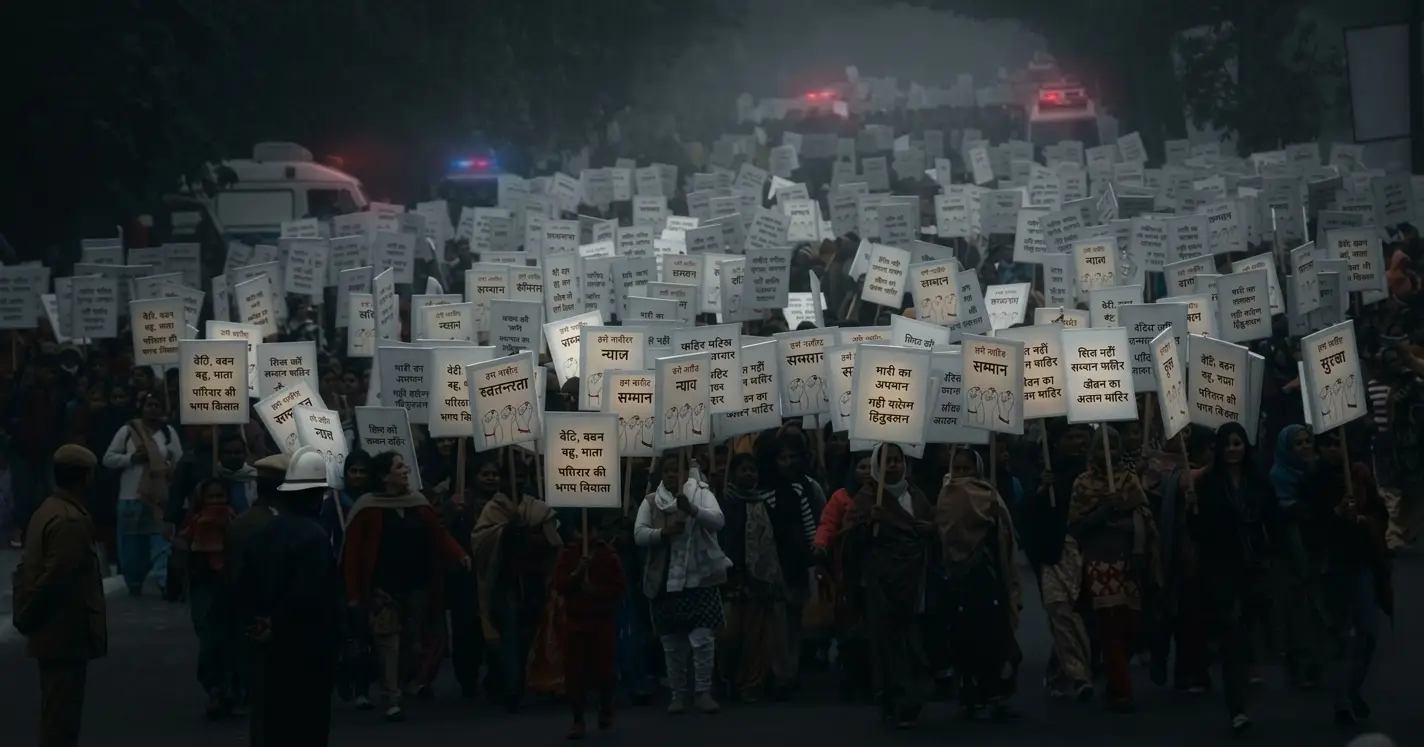
At a protest in Delhi against rising cases of sexual violence, one hoarding read: “Educate your son before you send your daughter outside.” It’s a message repeated in every awareness campaign and every op-ed after a case makes headlines.
Before I go further, my heartfelt condolences to the victim and her family. No one should ever have to go through this.
1: Does Literacy Actually Prevent Rape?
Short answer: No — not on its own.
- Countries with near-universal literacy do not report anywhere close to zero cases of sexual violence.
- What differs between countries isn’t the underlying rate of violence — it’s how completely each country’s data captures it:
- Whether male victims are legally counted
- Whether marital rape is recognized
- How much of it gets reported at all
- In India, offenders appear across every education level — graduates, under-matric, and illiterate offenders all show up in the data. An “educated” offender is not a contradiction.
2: What the Poster Leaves Out — Rape Happens to Boys Too
The “educate your son, protect your daughter” framing quietly assumes only girls are victims. The data — global and Indian — doesn’t support that assumption.
| Data Point | Source | |
|---|---|---|
| USA (men) | 1 in 6 men (16.9%) experienced contact sexual violence in their lifetime | CDC NISVS |
| USA (men, broader) | ~1 in 3 men experienced sexual violence, physical violence, or stalking by a partner | CDC |
| India (children, both genders) | 53% of surveyed children reported facing sexual abuse — of victims, 53% were boys | 2007 MWCD/UNICEF study |
| India (reporting) | 70% of abused children, regardless of gender, never told anyone | 2007 MWCD/UNICEF study |

Why India has almost no official data on adult male rape victims — it’s a legal gap, not just a cultural one:
- Section 63, Bharatiya Nyaya Sanhita (BNS) — replaced IPC Section 375 in 2024 — defines rape strictly as man against woman. Only a woman can legally be a “victim”; only a man can be the accused.
- Male and transgender victims fall entirely outside this definition.
- It’s gotten narrower, not better: the old IPC’s Section 377 was sometimes used (imperfectly) to prosecute male sexual assault. The BNS removed Section 377 entirely, with no replacement for adult male/transgender victims.
- Net result: male rape currently has no dedicated legal recognition in Indian criminal law.
Why the silence on both sides?
- A girl often fears being called “characterless”
- A boy often fears being seen as “not man enough”
- Different fears → same outcome: silence, and a system that wasn’t built to fully hear either of them
3: What Actually Drives Sexual Violence (Not What We Assume)
| Common Assumption | What the Data Actually Shows |
|---|---|
| Rape is mostly committed by strangers | 94–97% of cases involve someone known to the victim — relative, neighbour, friend |
| Alcohol is the main cause | Alcohol is a factor in a minority of cases — most reported assaults happen fully sober |
| The legal system delivers justice | Conviction rates hover around 27–28%; cases often take years |
| Porn has no real-world effect | Kids now reach explicit content years before any school conversation on consent — creating a gap with no framework |
4: Does Development = Fewer Cases? (No — and Here’s Why)
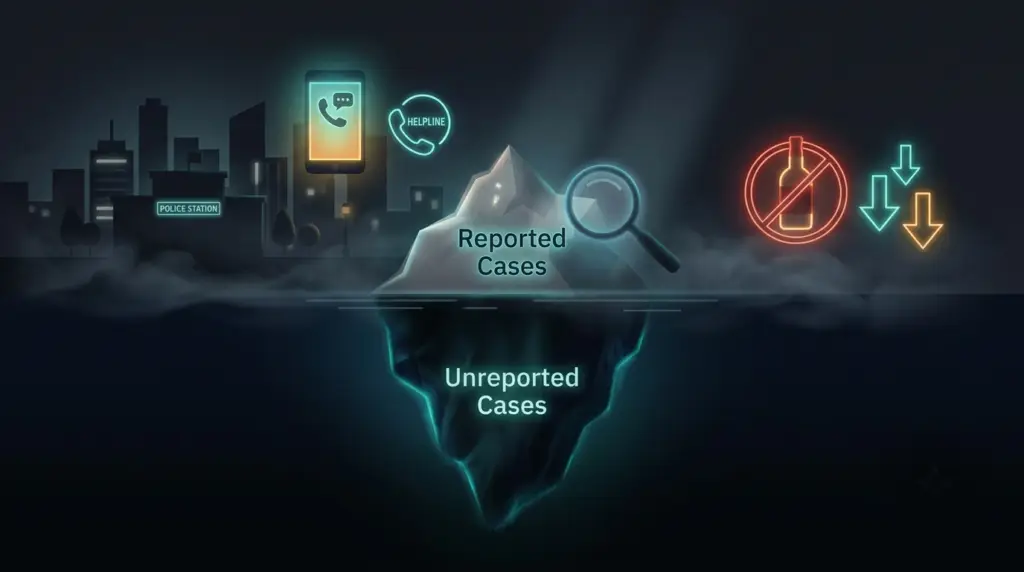
- More “developed” states often show more reported cases, not fewer — because better awareness and police access improve reporting, not necessarily the underlying rate.
- A low case count is not proof of safety — it can just mean worse reporting.
- Development also introduces new risks: dating-app harassment, drink-spiking, workplace harassment, hostel ragging (which affects boys as much as girls).
One policy that actually worked — Bihar’s 2016 alcohol ban:
- 3.6 percentage-point decrease in reported sexual violence
- 4.6 percentage-point decrease in emotional violence
- 37% drop in domestic violence cases (IPC 498A) in the years after the ban (Source: Lancet Regional Health – Southeast Asia / NCRB-based reporting)
5: What Should Actually Be Taught — And To Whom
- Teach boys, starting well before Class 12:
- Consent is an active yes — not the absence of a no
- Masculinity built on control (not protection) is a root cause here
- Boys can be victims too — it is never their shame to carry
- Being intoxicated, or having paid for a date, is never consent
- Teach both boys and girls, from an early age:
- Body autonomy — “good touch, bad touch,” taught before adolescence
- Digital safety — sextortion targets boys as much as girls
- Bystander responsibility — don’t laugh along when a friend crosses a line
- Teach girls — not just for safety, but for power:
- Financial independence is one of the strongest protections against staying in an abusive situation
- Practical legal knowledge — helplines, right to file a Zero FIR at any station
- Self-defence as a last resort, not the first line of defence
- Teach parents:
- Teaching a son to “behave outside” matters far less than teaching him to behave inside the house
- Since most offenders are known to the victim, what a child witnesses at home shapes far more than any outside lecture
Real-World Proof: Kenya Tried This, and It Worked
This isn’t theoretical. A country has actually run this exact model — gender-specific, consent-based education for both boys and girls — and measured the results.
Program: IMpower, run by the NGO No Means No Worldwide, rolled out across schools in Nairobi, Kenya, starting 2010.
What it taught:
| Audience | Curriculum |
|---|---|
| Girls | Consent, confidence, bodily autonomy, physical self-defence |
| Boys | Respect for women, challenging rape myths, positive masculinity, how to intervene as a bystander |
Measured results:
- 51% decrease in reported rape incidents among trainees who completed the program
- ~50% of girls who completed the course personally stopped an attempted rape within a year of finishing it
- Results were strong enough that the model was later replicated in Malawi (with UNICEF support) and Uganda
6: What Could Actually Fix This
| Solution | What It Would Do |
|---|---|
| Gender-neutral rape law | Recommended by the Justice Verma Committee (2012) — still not implemented. UK, Canada, Australia already have this. |
| Safety-by-design | Well-lit public spaces, CCTV, visible facilities, no blind spots — in schools, hostels, bus stops |
| Faster courts + crisis centers | Combine medical, police, and counselling support within hours — forensic evidence has a short window |
| Alcohol control + economic access |
What I Think: “You Can’t Expect Justice From a System Where the Policymakers Are the Accused”

Every solution in Step 6 — gender-neutral law, faster courts, safety-by-design — depends on one thing: a legislature willing to actually pass and fund it. That’s worth questioning, because the people writing India’s laws are not a clean sample.
The numbers, from the Association for Democratic Reforms (ADR) — India’s own poll-watchdog, built specifically to track candidates’ sworn criminal affidavits:
| Lok Sabha (Lower House) | % of winning MPs with any declared criminal case | % with serious criminal cases (incl. rape, murder, kidnapping, crimes against women) |
|---|---|---|
| 2004 | 23% | — |
| 2009 | 30% | 14% |
| 2014 | 34% | 21% |
| 2019 | 43% | 29% |
| 2024 | 46% (251 of 543 MPs) | 31% (170 of 543 MPs) |
That’s a 124% rise in MPs with serious criminal cases since 2009 — in just three election cycles.
Why I Don’t Expect This Soon — The Education Math Doesn’t Support It Either
Everything in Step 5 and the Kenya example above depends on one resource: a functioning school system reaching every child. India’s own numbers suggest that’s still a long way off — not because the goal is wrong, but because the money and the literacy base needed to get there aren’t in place.
The illiteracy gap is still enormous:
| Metric | Figure | Source |
|---|---|---|
| Overall literacy rate (age 7+) | 81.1% | PLFS 2025 |
| Rural female literacy | 70.3% | PLFS 2025 |
| Urban vs. rural literacy gap | 11.6 percentage points | PLFS 2025 |
| Estimated illiterate population | Roughly 240–250 million people — on the scale of the entire population of Indonesia, the world’s 4th most populous country | Calculated from PLFS 2025 literacy rate applied to India’s population aged 7+ |
And the money that is allocated often doesn’t even reach schools on time:
- Samagra Shiksha Abhiyan (India’s largest school education scheme): only 54.9% of its 2025–26 budget had been utilised with just six days left in the financial year
- PM-USHA (the scheme funding state public universities): averaged just 16% budget utilisation across 2022–2025, per PRS Legislative Research
- ULLAS, India’s own adult-literacy programme — the scheme directly meant to fix the illiteracy numbers above — has had its budget flat at ₹160 crore for four straight years (2024–25 to 2026–27), which a parliamentary panel itself called “inadequate” given the scale of adult illiteracy still in the country
Put together, this is a double failure, not a single one: the government has never funded education to its own promised target in almost 60 years of promising it, and a meaningful share of even the reduced amount it does allocate goes unspent or arrives too late to use. A country that can’t fully spend ₹12,467 crore meant for its largest school scheme, and funds adult literacy at a flat rate while over 200 million adults remain unable to read, is not currently positioned to deliver Kenya-style consent education at national scale — regardless of how badly it’s needed. That’s the honest, unglamorous reason this is likely to take far longer than anyone wants to admit.
The Rewrite
That Delhi hoarding wasn’t wrong — it was just incomplete.
Educate your son to understand what “no” means. Educate your daughter — and your son — that they’re allowed to report it when “no” is ignored. Educate the system to actually follow through when they do.
A safe India isn’t one where women stay indoors after dark. It’s one where both your daughter and your son can walk outside at 10 PM and come home safe — and where the law recognizes it, whoever the victim is.
Sources
https://www.ibanet.org/new-criminal-laws-legalise-male-rape-in-India
https://www.aljazeera.com/news/2007/4/9/child-abuse-widespread-in-india
https://shethepeople.tv/news/94-percent-offender-known-rape-survivor-ncrb-data
https://scroll.in/article/976919/scroll_in
https://wol.iza.org/news/no-means-no-how-consent-classes-in-kenya-reduced-incidents-of-rape-by-51
https://www.adrindia.org/node/96376
https://scroll.in/article/1078655/scroll_in
https://dataforindia.com/literacy-in-india/