
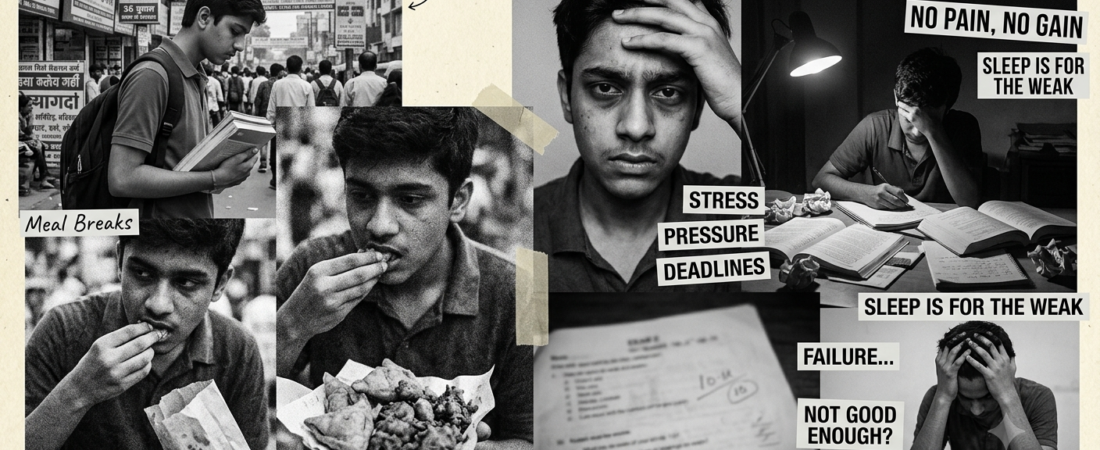
Every year, lakhs of 16, 17, and 18-year-olds across India disappear into the same machine: wake up at 5 AM, coaching class, mock tests, more coaching, home, sleep, repeat. We call it “dedication.” We call it “the sacrifice you make for your future.” What we rarely call it — even though it is — is damage.
I know, because I lived it.
The Story Nobody Puts in the Success Reels
In 2019, I was 18 and prepping for JEE like every other kid in my batch — chasing a rank, chasing a college, chasing a version of “success” that was handed to me before I even knew what I wanted. Somewhere in that pressure, my body started giving me warning signs. I was losing hair in clumps. At 18. I didn’t even have the vocabulary to understand that this was my body reacting to chronic stress — I just thought something was medically wrong with me.
A government doctor prescribed me a cocktail of medicines and Minoxidil without asking a single question about why an 18-year-old was losing hair. No one asked about sleep. No one asked about stress. No one asked about diet. The system isn’t built to ask — it’s built to push you toward the next mock test.
I didn’t qualify JEE in my first attempt. And what followed wasn’t just disappointment — it was a depression I didn’t have language for, that took roughly four years to fully claw back from.
I’m not telling you this for sympathy. I’m telling you because I know I wasn’t the only one.
What the Coaching Culture Doesn’t Tell You
1. Hairfall and skin issues are extremely common — and rarely investigated properly
Chronic stress disrupts your hormonal balance and nutrient absorption, which shows up physically — hairfall, acne, fatigue — long before it shows up as a diagnosable “mental health issue.” Most students (and most doctors treating them) chase the symptom with a cream or a tablet instead of asking what two years of 14-hour days and constant testing anxiety is doing to a still-developing teenage body.
2. Sleep deprivation is treated as a badge of honor
“I slept 4 hours and revised till 2 AM” is said like a flex in almost every coaching WhatsApp group. It’s not discipline — it’s a recipe for burnout, poor memory retention (ironically, the opposite of what you need for an exam), and long-term health consequences that don’t announce themselves until years later.
3. Nutrition is an afterthought
Between coaching, tuition, and self-study, meals get skipped, rushed, or replaced with whatever’s fastest. Deficiencies build silently — iron, B12, Vitamin D — the kind you don’t notice until a random blood test years later explains why you’ve felt foggy, tired, and low for so long. (I found out mine the hard way — you can read that story here if you haven’t already.)
4. One failed attempt is treated like a life sentence
Not qualifying on your first attempt gets treated — by the system, by relatives, sometimes by yourself — like the story is over. It isn’t. But at 17 or 18, with no framework for processing failure, that message can trigger a spiral that has nothing to do with your actual potential and everything to do with how narrowly “success” was defined for you.
5. There’s no aftercare — win or lose
If you crack the exam, you’re immediately expected to move on and “perform” at the next level. If you don’t, you’re often just… left. No one checks in on the mental toll either way. The system optimizes for the exam, not for the human being who took it.
What I Wish Someone Had Told Me at 18
- Your worth is not your rank. I know that sounds like a poster on a counselor’s wall, but it’s true, and nobody says it while you’re in it — only after.
- Physical symptoms are data, not distractions. If your body is giving you warning signs — hairfall, exhaustion, appetite changes — it’s not weakness, it’s information. Get it checked properly, don’t just medicate the symptom.
- Rest is not the enemy of preparation. A tired brain doesn’t retain information well. Burnout doesn’t make you more competitive — it makes you less capable, right when you need to be at your sharpest.
- One outcome does not define the next ten years. I didn’t qualify JEE the first time. I qualified the second time. Neither outcome was the full story — the four years after mattered just as much as the exam itself.
What Needs to Change
This isn’t a rant against ambition or hard work — I still believe in both. It’s a call for coaching institutes, parents, and students themselves to stop treating physical and mental health as optional extras to “deal with later.” Later often turns into years of recovery that could’ve been avoided with a little honesty during the process instead of after the damage is done.
If you’re a student going through this right now: check in with your body. Get bloodwork done if something feels off — don’t wait years like I did. Talk to someone, even if it’s just a friend, instead of sleeping through the discomfort like I did.
If you’re a parent: ask your kid how they’re doing, not just how their mock test score was.
Final Thought
Suffering is part of chasing something big — that part’s unavoidable. But suffering silently, without anyone naming what’s actually happening to you, is avoidable. I wish someone had named it for me at 18. I’m naming it now, for whoever needs to hear it.
If this resonated, you might also want to read how I regrew my hair after years of stress-related hairfall and how I overcame depression and mental fog without therapy — the fuller story behind this one.
FAQ: JEE/NEET Stress and Health
Can coaching stress really cause hair loss? Yes — chronic stress can push hair follicles into a resting phase prematurely, a condition often called stress-related telogen effluvium, leading to noticeable shedding within a few months of sustained high stress.
How do I know if my hairfall or fatigue is stress or a deficiency? The only reliable way is a proper blood test — checking hemoglobin, Vitamin D, Vitamin B12, and iron levels — rather than guessing or self-medicating.
What should I do if I didn’t qualify JEE/NEET on my first attempt? Give yourself room to process it as one outcome, not a final verdict. Many successful candidates, including myself, qualified on a second attempt — the gap between attempts is often more about mindset and health recovery than raw preparation.
This post reflects personal experience and general awareness, not medical advice. If you or someone you know is struggling with the pressures of exam preparation, please consider speaking with a qualified doctor or mental health professional.