Category: RATIONAL THINKING

  • The Real Cost of India’s Coaching Culture: How JEE/NEET Prep Is Silently Wrecking Students’ Health (And Nobody’s Talking About It)

    The Real Cost of India’s Coaching Culture: How JEE/NEET Prep Is Silently Wrecking Students’ Health (And Nobody’s Talking About It)

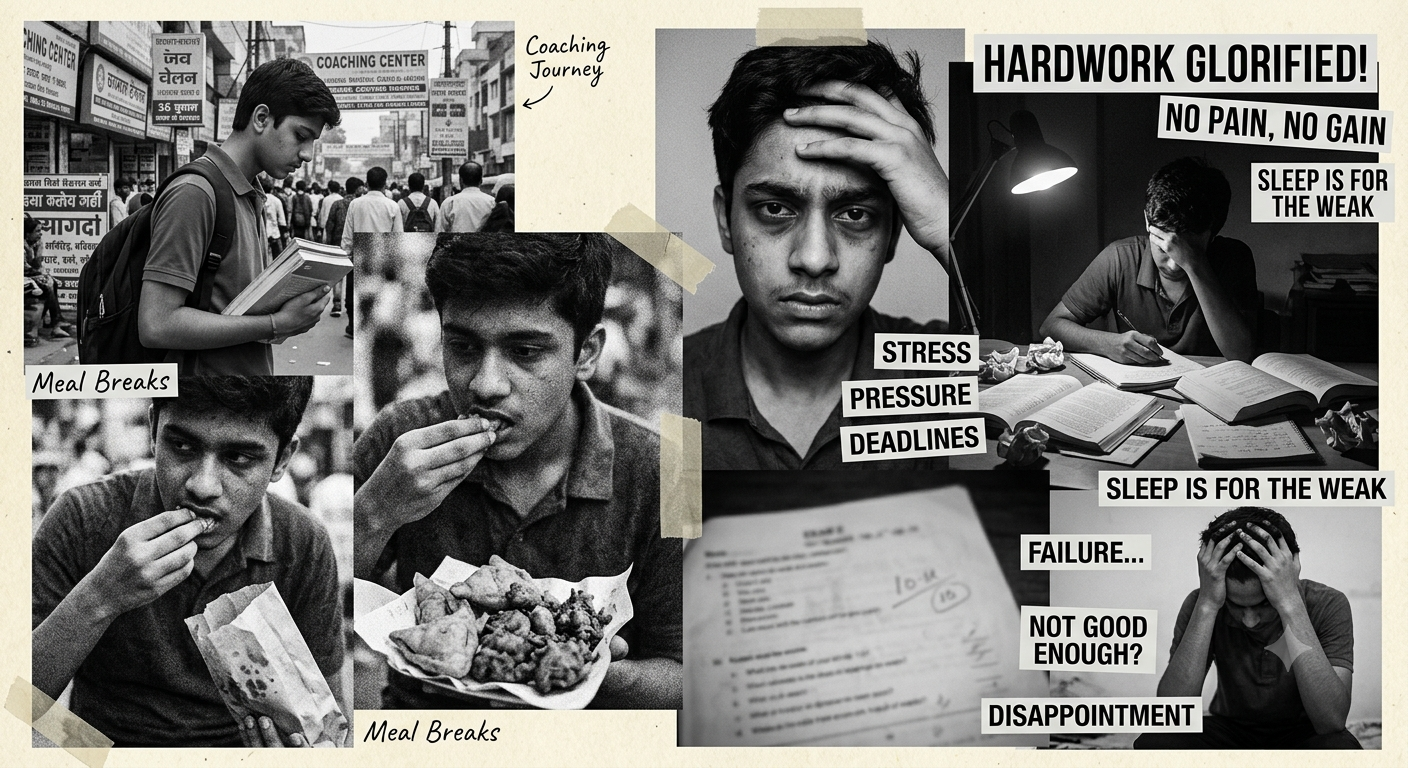
    Every year, lakhs of 16, 17, and 18-year-olds across India disappear into the same machine: wake up at 5 AM, coaching class, mock tests, more coaching, home, sleep, repeat. We call it “dedication.” We call it “the sacrifice you make for your future.” What we rarely call it — even though it is — is damage.

    I know, because I lived it.

    The Story Nobody Puts in the Success Reels

    In 2019, I was 18 and prepping for JEE like every other kid in my batch — chasing a rank, chasing a college, chasing a version of “success” that was handed to me before I even knew what I wanted. Somewhere in that pressure, my body started giving me warning signs. I was losing hair in clumps. At 18. I didn’t even have the vocabulary to understand that this was my body reacting to chronic stress — I just thought something was medically wrong with me.

    A government doctor prescribed me a cocktail of medicines and Minoxidil without asking a single question about why an 18-year-old was losing hair. No one asked about sleep. No one asked about stress. No one asked about diet. The system isn’t built to ask — it’s built to push you toward the next mock test.

    I didn’t qualify JEE in my first attempt. And what followed wasn’t just disappointment — it was a depression I didn’t have language for, that took roughly four years to fully claw back from.

    I’m not telling you this for sympathy. I’m telling you because I know I wasn’t the only one.

    What the Coaching Culture Doesn’t Tell You

    1. Hairfall and skin issues are extremely common — and rarely investigated properly

    Chronic stress disrupts your hormonal balance and nutrient absorption, which shows up physically — hairfall, acne, fatigue — long before it shows up as a diagnosable “mental health issue.” Most students (and most doctors treating them) chase the symptom with a cream or a tablet instead of asking what two years of 14-hour days and constant testing anxiety is doing to a still-developing teenage body.

    2. Sleep deprivation is treated as a badge of honor

    “I slept 4 hours and revised till 2 AM” is said like a flex in almost every coaching WhatsApp group. It’s not discipline — it’s a recipe for burnout, poor memory retention (ironically, the opposite of what you need for an exam), and long-term health consequences that don’t announce themselves until years later.

    3. Nutrition is an afterthought

    Between coaching, tuition, and self-study, meals get skipped, rushed, or replaced with whatever’s fastest. Deficiencies build silently — iron, B12, Vitamin D — the kind you don’t notice until a random blood test years later explains why you’ve felt foggy, tired, and low for so long. (I found out mine the hard way — you can read that story here if you haven’t already.)

    4. One failed attempt is treated like a life sentence

    Not qualifying on your first attempt gets treated — by the system, by relatives, sometimes by yourself — like the story is over. It isn’t. But at 17 or 18, with no framework for processing failure, that message can trigger a spiral that has nothing to do with your actual potential and everything to do with how narrowly “success” was defined for you.

    5. There’s no aftercare — win or lose

    If you crack the exam, you’re immediately expected to move on and “perform” at the next level. If you don’t, you’re often just… left. No one checks in on the mental toll either way. The system optimizes for the exam, not for the human being who took it.

    What I Wish Someone Had Told Me at 18

    • Your worth is not your rank. I know that sounds like a poster on a counselor’s wall, but it’s true, and nobody says it while you’re in it — only after.
    • Physical symptoms are data, not distractions. If your body is giving you warning signs — hairfall, exhaustion, appetite changes — it’s not weakness, it’s information. Get it checked properly, don’t just medicate the symptom.
    • Rest is not the enemy of preparation. A tired brain doesn’t retain information well. Burnout doesn’t make you more competitive — it makes you less capable, right when you need to be at your sharpest.
    • One outcome does not define the next ten years. I didn’t qualify JEE the first time. I qualified the second time. Neither outcome was the full story — the four years after mattered just as much as the exam itself.

    What Needs to Change

    This isn’t a rant against ambition or hard work — I still believe in both. It’s a call for coaching institutes, parents, and students themselves to stop treating physical and mental health as optional extras to “deal with later.” Later often turns into years of recovery that could’ve been avoided with a little honesty during the process instead of after the damage is done.

    If you’re a student going through this right now: check in with your body. Get bloodwork done if something feels off — don’t wait years like I did. Talk to someone, even if it’s just a friend, instead of sleeping through the discomfort like I did.

    If you’re a parent: ask your kid how they’re doing, not just how their mock test score was.

    Final Thought

    Suffering is part of chasing something big — that part’s unavoidable. But suffering silently, without anyone naming what’s actually happening to you, is avoidable. I wish someone had named it for me at 18. I’m naming it now, for whoever needs to hear it.


  • How I Regrew My Hair After Losing It to Stress, Depression, and Vitamin Deficiency (My 4-Month Comeback)

    How I Regrew My Hair After Losing It to Stress, Depression, and Vitamin Deficiency (My 4-Month Comeback)

    By Aditya Dev Ranjan

    If you’re losing hair in your late teens or twenties and doctors keep handing you Minoxidil without ever asking why — this post is for you. This isn’t a “5 hacks for hair growth” post. This is my actual story, the mistakes I made, and what finally worked.

    Where It All Started: JEE Prep, 2019

    I was 18, deep in my JEE preparation, and more stressed than I’d ever been in my life. Somewhere in that pressure-cooker year, I started noticing clumps of hair coming out. For an 18-year-old, losing hair isn’t just a cosmetic problem — it’s terrifying. It messes with your confidence at exactly the age when you’re figuring out who you are.

    The Mistake: Medicine Before Diagnosis

    My mother and I went to a government doctor, hoping for answers. Instead of investigating the actual cause, he prescribed a bunch of medicines along with Minoxidil — for an 18-year-old, without ever checking what was causing the hairfall in the first place.

    I didn’t know any better, so I used it. Three months in, my hairfall got worse, not better. And on top of that, coming from a middle-class family, that ₹500 bottle of Minoxidil plus the other medicines was costing me close to ₹3,000 a month — money we genuinely couldn’t spare. I quit.

    Lesson #1: Hairfall is a symptom, not a disease. Treating the symptom without finding the root cause rarely works — and it can cost you more than money.

    When Everything Fell Apart

    Around the same time, I didn’t clear JEE in my first attempt. That hit me hard. I slipped into a depression I didn’t even have a name for back then — I just wanted to disappear from reality, so I slept. Day into night into day again.

    Then COVID happened, and I moved back to my village, where family issues piled on top of everything else. In the middle of all that chaos, I somehow managed to qualify JEE and get into an architecture program — but the mental damage from that one year took nearly four years to fully recover from.

    By the last years of college, I started gymming. I built a decent physique in about six months — but I was hollow on the inside. The body had changed; the mind hadn’t caught up.

    The Turning Point: A Blood Test I Almost Didn’t Take

    After graduating, my brother was getting a blood test done for a deficiency check, and I decided to tag along and get mine done too. That single decision changed everything.

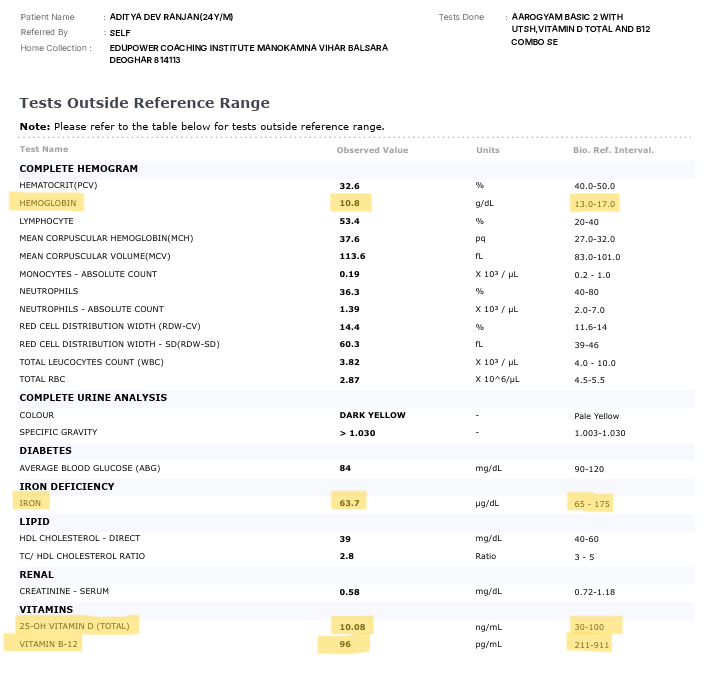
    My report came back with:

    • Mild anemia — hemoglobin at 10.8 g/dL
    • Low Vitamin D
    • Severely low Vitamin B12 — 96 pg/mL, against a healthy range of 211–911 pg/mL

    Suddenly, years of hairfall, fatigue, and brain fog had an actual, physical explanation. This wasn’t just “stress” — my body had been running on empty for years.

    Taking My Life Back: The Routine That Worked for Me

    I got a decent job, joined a gym, and instead of throwing random medicines at the problem again, I started learning how nutrients actually work together. That was the real shift — understanding that:

    • Magnesium needs K2
    • Vitamin D needs magnesium
    • Iron needs Vitamin C
    • Calcium needs Vitamin D

    Everything in the body is interrelated. Popping one supplement in isolation rarely fixes anything.

    My typical day now looks like this:

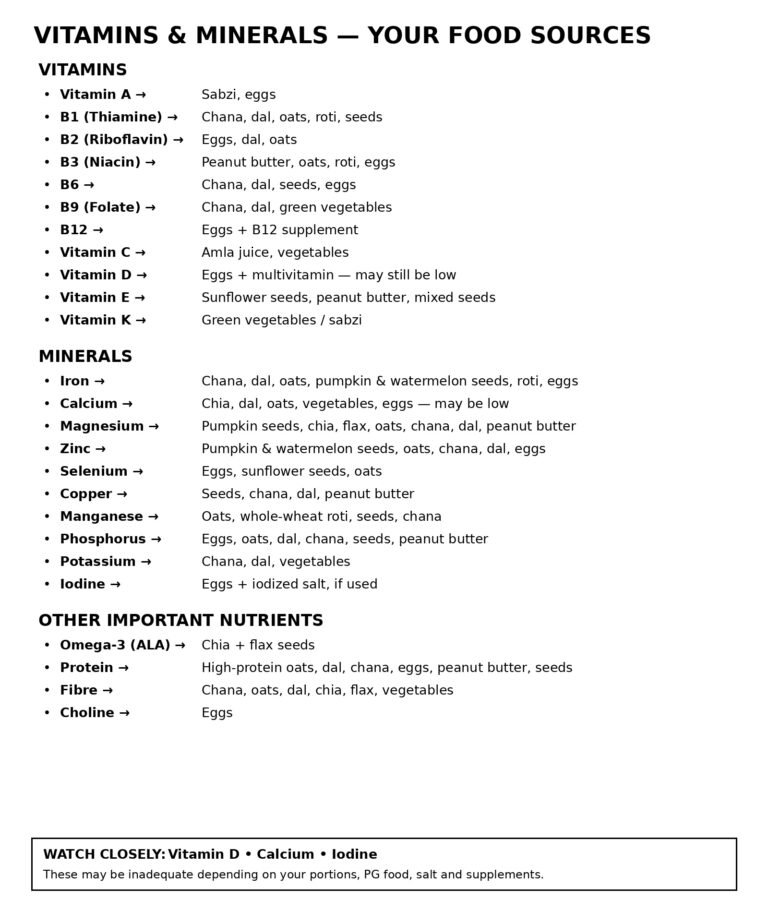
    • Morning: Vitamin C first — usually amla juice — plus soaked brown chana (overnight, with jaggery)
    • Pre-gym: Creatine
    • Post-gym breakfast: Roti and sabzi, a scoop of good-quality peanut butter, and a handful of mixed seeds (pumpkin, watermelon, sunflower, chia, flax)
    • Lunch: Rice, dal, sabzi, and 100g of high-protein oats (roughly 54g of protein on its own)
    • Evening: 3–4 eggs
    • Dinner: Regular PG food
    • Alongside this: a multivitamin every alternate day and a B12 supplement, based on what my blood work showed I was deficient in

    (Quick disclaimer: this is what worked for me, based on my own blood test results — not a prescription for anyone else. Please get your own bloodwork done and talk to a doctor before starting any supplement routine.)

    Where I Am Now — 4 Months In

    I started this routine in May 2026, so this is about four months of consistency. I’m not “fully recovered” — hair regrowth takes time — but here’s what has changed:

    • My mental health has improved massively
    • I feel genuinely happier
    • My cognitive ability is sharper
    • I feel full of life again, not just physically but mentally

    The Real Takeaway

    If your hairfall is tied to stress, depression, or a deficiency your body’s been quietly screaming about — chasing shampoos and Minoxidil without checking the actual cause is often just throwing money at a symptom. Get your bloodwork done. Fix the body and the mind together. The hair often follows.

    Suffering is part of being human — that’s not the part you get to choose. But how you respond to it? That part is yours.

    I’ll see you in the next vlog, where I talk about how I dealt with depression and brain fog — no therapy, just self-work. Till then, this is Aditya Dev Ranjan. Bye.


    This post is based on personal experience and is not medical advice. Please consult a doctor and get proper bloodwork done before starting any supplement or medication routine